 By SamahGassab2026
 The document must be submitted by the signatory in person to the civil status officers.
Signature legalization is carried out upon presentation of one of the following official documents:
The signature must be personal and made in the presence of a civil status officer
By SamahGassab2026 Coverage rate of the paved road network within the municipal area
By SamahGassab2026 Key institutions and essential services within the municipal area
By SamahGassab2026 M’saken was founded by a group of Chorfas whose ancestors migrated from the Hejaz in the East to the Maghreb during the period of Idrisid rule.
At the beginning of the 8th century of the Hijri calendar, some of their descendants moved to Ifriqiya, settling first in Kairouan for a period before relocating to the Sahel region. They initially settled in the village of “El Frayate” and later established themselves on land known as “Chaabat Essayd”, which was subsequently called “Chaabat Essoltane” in reference to the Hafsid Sultan who granted them ownership of the land.
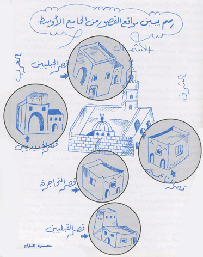
Upon their settlement, they divided into five clans, each occupying a specific area of the territory. They built five fortified settlements (ksour) on the highest points, surrounding a central mosque known as the Grand Mosque. The first ksour that formed the city of M’saken are:
Ksar Ennajjagra: located near the mosque on the southern side
Ksar El Qiblien: south-east of the mosque, behind Ksar Ennajjagra
Ksar El Manaâma: east of the mosque
Ksar El Jebliyen: north of the mosque
Ksar El Jdidiyen: west of the mosque
As for the origin of the name “M’saken” (singular: Maskan), it refers to a collection of dwellings. This designation became widespread among surrounding villages, which referred to the area as “M’saken El Achraf”. Over time, the name “M’saken” replaced the original name “Ksour El Achraf”.
References: “Silsilat Al-Ousoul fi Shajarat Abnaâ Ar-Rassoul” by Sheikh Abdallah Acharif and “Dourar Al-Achraf”, compiled by Mohamed El Gazzah and Sheikh Salah El Gazzah in 1355 AH / 1936 AD.
By SamahGassab2026 La ville de M’saken est située dans le Sahel tunisien, à proximité de la route nationale n°1 reliant Sousse à Sfax, ainsi que de la route régionale n°100 reliant Kairouan à Monastir. Elle relève administrativement du gouvernorat de Sousse et est érigée en municipalité depuis le 19 février 1921.
M’saken est reliée aux autres régions du pays par des routes principales et secondaires. D’un point de vue topographique, la région appartient au Sahel bas et bénéficie d’un climat méditerranéen.
La région de M’saken est couverte de vastes oliveraies, en plus de terres agricoles, de champs et de nombreux vergers.
Page 4 of 6